Why Vibe Coding Fails in Production (and What to Do Instead)
The Vibe Coding Honeymoon
In February 2025, Andrej Karpathy posted a tweet that became the unofficial manifesto of a generation of developers. He described a new approach he called "vibe coding," where you fully give in to the vibes, let AI write the code, and forget that the code even exists. The tweet hit over 4.5 million views. By November, Collins Dictionary named it Word of the Year 2025.
And honestly? It works. For prototypes, weekend projects, and internal tools that three people use, vibe coding is magic. You describe what you want in plain English, an LLM generates the implementation, and you iterate through conversation instead of through sprints. What used to take weeks takes hours.
I saw this firsthand. Working directly with customers, I watched a team ship a fully functional piece of software in three days. It addressed an operational issue they had no time to work on for months, redundant database replications that were costing the company thousands of dollars. Three days. Problem solved. Money saved.
So what's the problem?
Where Vibe Coding Breaks Down
The problem is that vibe coding optimizes for the first deployment, not the next hundred. And in production, it's the next hundred that matter.
Security is absent by default
Researchers at Escape scanned over 5,600 publicly deployed vibe-coded applications and found more than 2,000 high-impact vulnerabilities and 400 exposed secrets. That's roughly one in three apps shipping with a serious security flaw anyone could exploit. Missing access controls, hardcoded credentials, unsanitized inputs, exposed PII including medical records, all sitting on the open web.
Architecture is an afterthought
The tools that generate code fast don't generate architecture at all. Authentication is bolted on as a demo feature. Error handling assumes clean inputs. Observability doesn't exist. Multi-tenant isolation? Rate limiting? Retry logic with idempotency? These aren't nice-to-haves. They're what separates a prototype from a production system.
Technical debt at AI speed
Here's the paradox: AI lets you accumulate technical debt faster than any human team could. You're not just writing code you don't fully understand. You're generating entire codebases that nobody understands. When something breaks at 2 AM, there's no mental model to debug from because no one made the architectural decisions consciously.
The enterprise gap
For any organization that needs compliance, audit trails, or traceability, vibe coding has no story. There's no record of why a decision was made. No requirements that were validated. No design document that a security review can reference. You have working software and a prayer.
The Core Problem: Speed Without Structure
Vibe coding collapses the distance between idea and artifact from months to hours. That's genuinely powerful. But when that distance collapses, every quality-control mechanism your organization built over the last thirty years gets bypassed by default.
The issue isn't AI writing code. AI writing code is great. The issue is AI writing code without a plan.
A developer who skips requirements, skips design, skips testing, and ships straight to production isn't "agile." They're reckless. We don't accept that from humans. Why would we accept it from AI?
Enter AIDLC: The AI Development Lifecycle
AIDLC is a framework I built to solve exactly this problem. It treats AI as a structured development collaborator, not a code printer you throw prompts at.
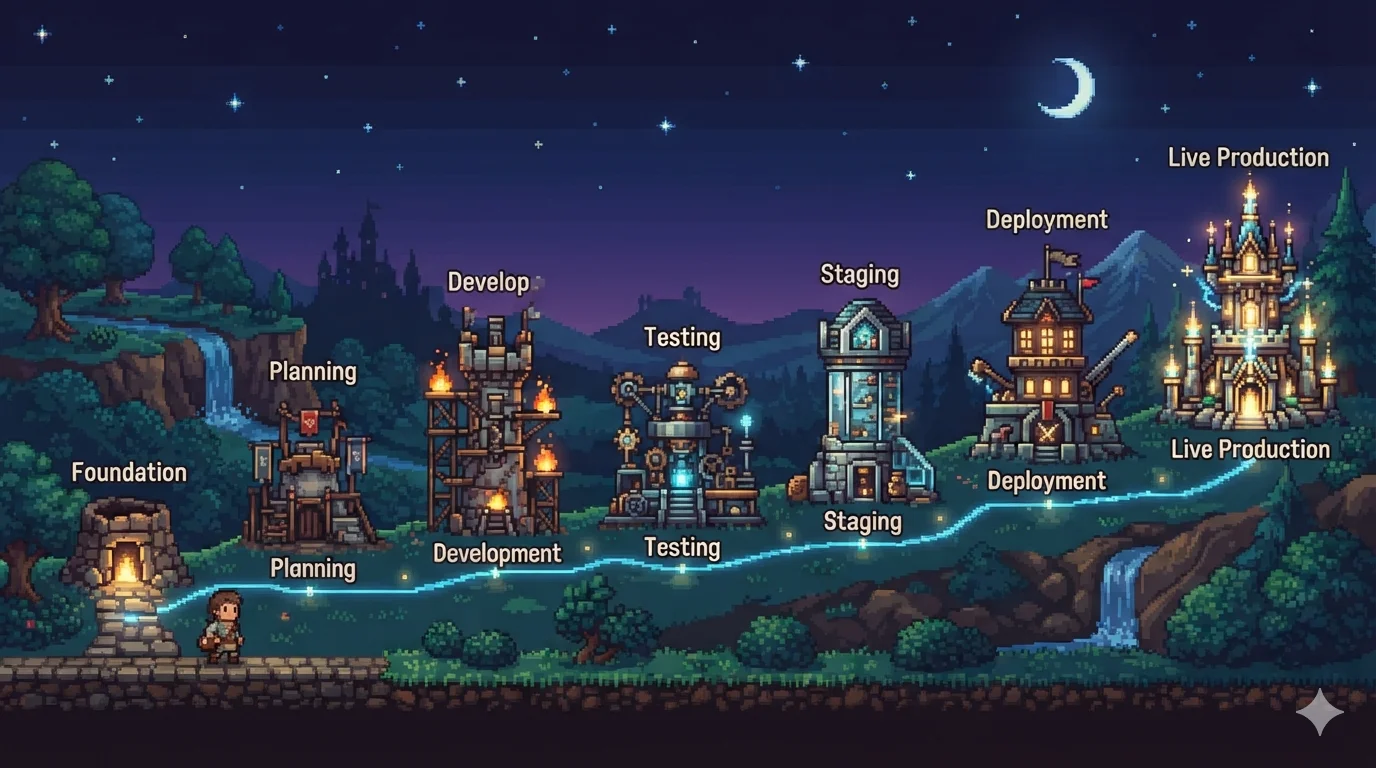
The idea is simple: keep the speed of AI-assisted development, but route it through the phases that make software production-ready.
The Seven Phases
- Ideation. Explore the problem space, define goals and constraints.
- Requirements. Write acceptance criteria and scope the work.
- Design. Define architecture, interfaces, and data flow.
- Implementation. AI writes the code, following the design.
- Testing. Verify against requirements, not just "does it run."
- Deployment. Release preparation and validation.
- Maintenance. Monitoring, iteration, documentation updates.
Not every task needs all seven. AIDLC supports three scopes:
- Full. All phases. Complex features, new systems.
- Standard. Requirements through Deployment. Most feature work.
- Micro. Implementation and Testing only. Bug fixes, small changes.
The right amount of process for the right size of work.
Why AIDLC Works Where Vibe Coding Doesn't
Traceability
Every phase produces artifacts. Requirements are documented. Design decisions are recorded. When something breaks six months later, you can trace back to why it was built that way. This isn't overhead. It's the difference between maintainable software and a black box.
Quality gates
You can't jump to implementation without requirements. You can't deploy without testing. The AI is powerful, but it operates within guardrails. This prevents the most common failure mode: generating code that "works" but solves the wrong problem or solves it unsafely.
Human control at every checkpoint
AI proposes. Human decides. At every phase transition, you review what was produced and approve or redirect. You're the architect. AI is the builder who follows your blueprints, not the other way around.
Scalability
A quick bug fix doesn't need a design document. A new distributed system does. AIDLC scales the process to match the complexity. Micro scope gets you the speed of vibe coding with the safety of verified tests. Full scope gives you the rigor of enterprise SDLC with the productivity of AI.
Tool agnostic
AIDLC isn't tied to one IDE or one AI model. It works with Kiro, Cursor, Claude, or whatever tool your team uses. The framework lives in your repo as state files and skill definitions. Portable, versioned, reviewable.
The Right Mental Model
Think of it this way:
- Vibe coding = AI as a contractor who builds whatever you describe. No blueprints, no permits, no inspection.
- AIDLC = AI as a skilled team member who follows engineering process, produces traceable work, and checks in with you at meaningful points.
Both use the same underlying AI capabilities. The difference is structure. And in production, structure is what keeps things running when you're asleep.
Try It Yourself
AIDLC is open source and ready to use today. Head to aidlc.rodrigoasensio.com to get started. You can be running it in your repo in under five minutes. No infrastructure required, just a set of skills and state files that guide your AI through structured development.
If vibe coding got you to the prototype, AIDLC gets you to production.